
Precision Laser
Micro-Machining
Laser cutting, welding, ablation and marking for medical device components, made to print in our ISO 13485:2016-certified facility.
Precision laser micro-machining uses a tightly focused laser beam to cut, weld, ablate or mark features too small or delicate for conventional tools. The beam never touches the part, so thin walls don’t deform, there’s no tool wear, and features repeat part after part.
NorthStar applies it to medical device components in metals and polymers, from first prototype through production.
Materials we process: 304 stainless steel · 316 stainless steel · stainless steel cable · flat sheet stock · polyimide · PTFE · braid-reinforced polymer tubing
What is precision laser micro-machining?
Hypotube & Thin-Wall Laser Cutting
We laser cut slots, spiral patterns and hole arrays into stainless steel hypotubes, thin-wall tubing and flat sheet. Every cut delivers clean, burr-free edges and consistent inner and outer diameters. Cut patterns let you tune a tube’s flexibility, torque response and kink resistance for catheter shafts, delivery systems and minimally invasive instruments.
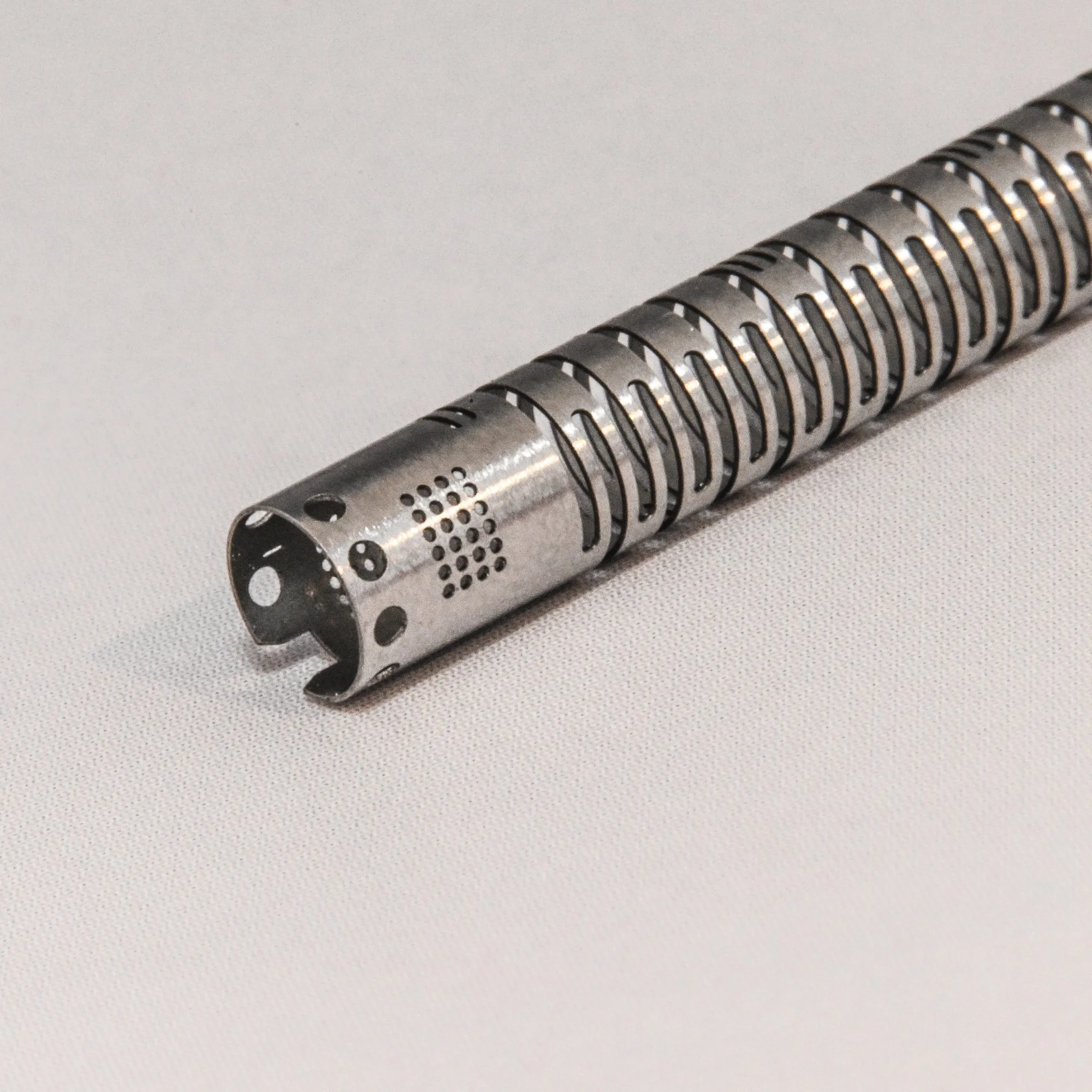
Hypetube with micro-hole array
Capabilities & Specifications304 stainless steel hypotube, rotational cutting
Tube: .153" OD × .007" wall
Array of 24 holes, .007" diameter each
Perimeter holes: .032" diameter
Kerf widths: .012" to .015"

Slotted 316 stainless steel tube
Capabilities & SpecificationsCutting and marking on 316 stainless steel
Tube = .127" OD X.016" wall X .538" length
Slot = .057" X .252 length and .030" X .090"

Welded and slotted 304 stainless steel tube
Capabilities & SpecificationsWelding, cutting and marking on 304 stainless steel
Tube: .248" OD × .027" wall × 1.5" length
Slots: .027" wide × .658" long

Flat sheet stock cutting
Complex 2D profiles cut from flat sheet stock with clean, burr-free edges.
Laser micro-welding joins miniature metal parts with a small, controlled heat-affected zone, so fine cable, wire and thin-wall bands keep their geometry. We combine welding with cutting and marking on the same part, which removes handoffs between suppliers.
Example: cable-to-band weld
304 stainless steel cable welded to stainless steel band
Cable = 12 strand X .009" diameter
Anchor band = .092" OD X .010" wall
Laser micro-welding
Polyimide & PTFE laser ablation and stripping
Laser ablation removes polyimide, PTFE and other polymer layers in controlled passes, exposing the braid or metal beneath without mechanical stress. Use it to open slots and windows in braid-reinforced tubing, add functional texture, and apply high-resolution marks across complex device surfaces.

Braid-reinforced polyimide tube with PTFE liner
Capabilities & Specifications
Ablation through polyimide and through PTFE
Tube: .096" OD × .006" wall
Slot: .030" wide × .125" long


From functional texturing to high-resolution marking, ablation improves performance, identification and compliance on flat and cylindrical parts.
High-definition laser marking
We produce deep, ultra-dark laser marks for logos, serial numbers, part identifiers, and orientation or depth indicators, with crisp definition and exceptional readability.

Depth markers on stainless steel tubing
Marking of stainless steel tubing
Diameters from .010" to 6.00"

Linear graduation marking
1 mm to 50cm capability
Linear graduation marking

Complex Sub-assemblies
We manufacture the high-precision components at the core of minimally invasive and implantable devices, then assemble them. Cutting, welding, ablation, marking and assembly under one quality system means fewer suppliers and fewer handoffs.

Commercial applications
Our laser and micro-manufacturing processes also serve industrial, commercial and consumer products that need precision and durability, such as permanently marked threaded fittings.
What Our Customers Say.
Laser processing FAQs
-
Medical device makers use laser micromachining to cut hypotubes and catheter components, weld miniature metal parts, ablate polymer layers and permanently mark parts. It suits small features and thin walls that conventional machining would distort.
-
A laser-cut hypotube is a thin-wall metal tube with a cut pattern of slots, spirals or holes that sets how it bends, transmits torque and resists kinking. Catheters, guidewires and delivery systems use them. One of our examples is a .153" OD 304 stainless steel hypotube with a .007" wall and 24 holes of .007" diameter.
-
Yes. We ablate through polyimide and PTFE in controlled passes to expose the braid, for example .030" × .125" slots in a .096" OD braid-reinforced tube with a .006" wall. We confirm each new material stack on samples first.
-
Yes. We run rapid prototypes and quick-turn samples, then scale to high-volume production under the same ISO 13485 quality system.
Have a drawing? Get a quote.
Send your print, material and annual volume. We’ll review it and reply with next steps. Need supplier qualification documents? See our certifications →